OData API endpoint URIs
When your API Service component uses OData as the protocol, your OData URI has three components: a service root URI, a resource path, and query options.
-
The service root URI identifies the root of an OData service.
-
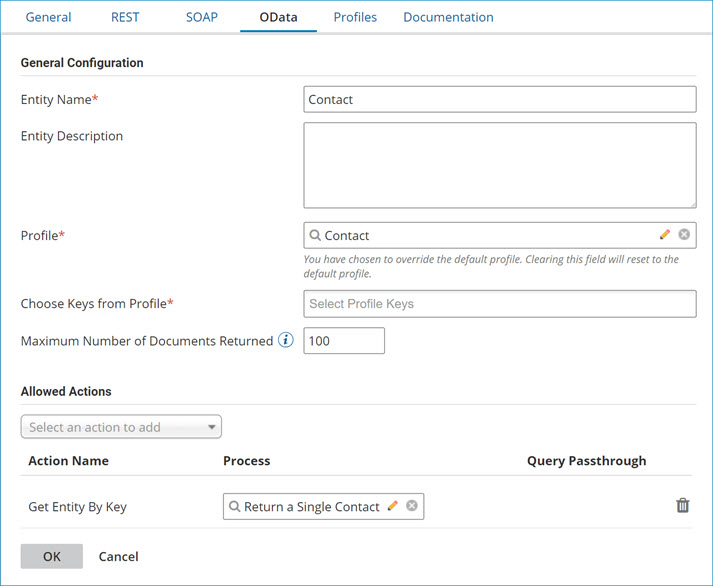
The resource path identifies the resource that you interact with and enables the data model (that is your profile). The resource path consists of entities, which have these characteristics:
-
A collection name for sets of entity types, such as products, categories, or suppliers.
-
A name that is different from the name of the set.
-
A primitive or complex property type. Primitive types consist of a named or typed property and a key. Complex types are containers and do not have keys.
-
A namespace - OData does not support the Empty Namespace like XML does. Because OData reserves System, Transient, and Edm, you cannot publish entities on those namespaces.
-
-
System Query Options control the amount and order of data that an OData service returns. The supported options are:
-
$orderby - in collections this option specifies the values to use to order the entries.
-
$top - identifies a subset by selecting only the first N items of the set. If you set the $top option to a value greater than that in Maximum Number of Documents Returned, the OData service returns only the value of Maximum Number of Documents Returned, along with the moreDataToken.
-
$skip - identifies a subset by seeking N entries into a collection, then selecting only the remaining entries. For example, when entry N=500, the OData service returns entries 501 and higher.
-
$filter - identifies a subset by selecting only entries that satisfy the specified predicate expression. Expressions can be properties and literals. Literal values can be strings within single quotes, numbers, or boolean values.
noteIf an entity's Get Entity action has the Query Passthrough option specified, the listener process linked to the action applies query filtering. The option does not support all $filter operators and methods. For more information about the Query Passthrough option, refer to the linked topic.
-
$select - identifies a value that specifies a response.
-
$inlinecount - specifies that the response include a count of the number of entries in the collection.
-
If the URI contains a $top or $skip query option but not an $orderby option, then the entries in the set are first fully ordered by the data service.
If a URI contains an $inlinecount and a $filter query option, you must apply $filter first.